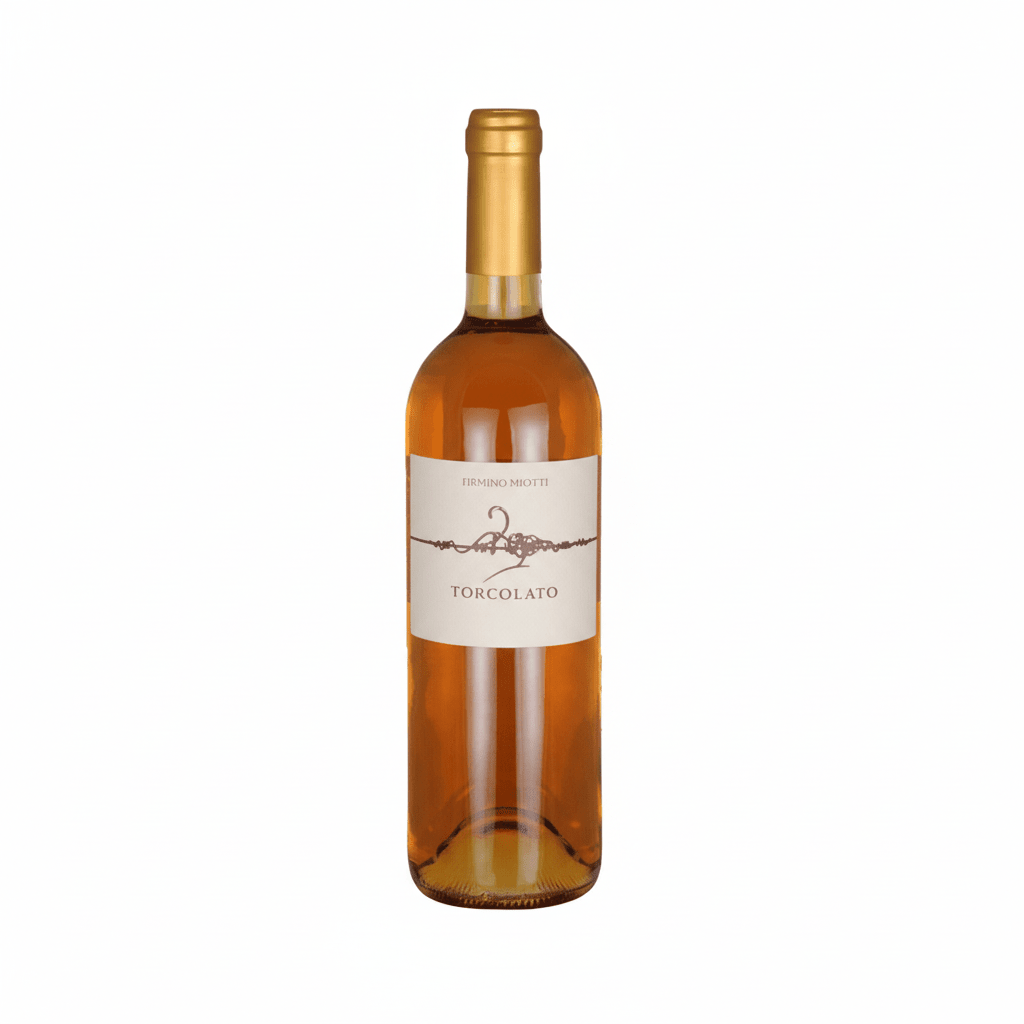
Firmino Miotti
Firmino Miotti Torcolato 2019 - 375ml
Firmino Miotti Torcolato 2019 - 375ml
Couldn't load pickup availability
How is Made
VINIFICATION: Grapes are pre harvested to keep acidity high, then they are coiled (intorcolà) on a string in an aired atmosphere, 3 months Air dried, follows a Spontaneous fermentation for 7 months. Then the ageing goes like this; 4 summers in steel, as sometimes the natural fermentation restarts and evolves the wine and minimum of 3 years in bottle before release.
CHARACTERISTICS: A wonderful color of gold with intense aroma of cooked apple, honey, apricot, raisins and dates. It fills the mouth with flavor. The freshness from the vespaiola grape allows it to contrast the sweetness and therefore is not overpowering but elegant. Torcolato is one of the great wines of meditation or conversation. It is excellent alone, but pairs well with herbed and aged cheeses. It also is a special dessert wine and goes well with dry biscuits. Torcolato ages well and is always a pleasant surprise when bottles from some decades before are opened.
The history of Torcolato

In the middle of the last century, A. B. Massalongo classified the fossil imprint of a bunch of grapes and a vine leaf. It is therefore probable that these vinaceae (Ampelophyllum) gave rise, after the glaciations, to spontaneous and wild vines and from these to Vitis Vinifera. Other archaeological discoveries, such as vases, glasses and cups from the Neolithic era have been found near Santorso (Bagolini, 1984).
In northern Italy, the vine certainly has a tradition that predates the Roman Empire; It is thought that the Venetians, who arrived in Italy in the Iron Age (11th-10th century BC), thanks to the trade relations established with the Etruscans, developed the agricultural economy by cultivating vines, wheat, barley, spelt, millet, along the hills near the Astico stream (Lovo and Onorato, 1998). The Celtic invasions broke the relationship between the Venetians and the Etruscans, and facilitated the establishment of equally good relations between the Venetians and the Romans.
During the Roman period, the wine produced in the Vicenza and Verona areas was called “retico” due to the name of the large production area, “Retica”, an area that includes the piedmont territories that go from Vicenza to Como (Buchi, 1987). The Venetians knew how to develop, in those years, a viticulture and an enology that were certainly appreciable, providing the Roman legionaries with the necessary provisions for the various war campaigns; even the restrictive agrarian laws of Domitian did not affect the winemaking of Vicenza, on the contrary the wine was in great demand.
The dark period that followed the Roman domination stopped with the Ostrogoths of Theodoric who, in 489, managed to ensure the region a period of peace to the advantage of agriculture and winemaking.
It was Cassiodorus (485-580) who restored prosperity to the Vicenza and Verona area, bringing the wines of the two cities to the court of Ravenna.
Among the other dominations, it is worth remembering the Edict of Rotari (643), which established the relationship between the Lombards and the conquered land, protecting the local economy (Deacon, 1878); Charlemagne, who in the year 800, issued the capitulary “De villis”, an ordinance that listed the plants that must be planted and cultivated in the royal domains.
In it, six articles concern the vine, its cultivation, the grape harvest and the production of wine.
With the invasions of the Hungarians, Venetian agriculture was destroyed (Fasoli, 1945) and to defend themselves from their invasions, castles and walls were built everywhere around the city, also fortifying the churches and abbeys, which became, in different ways and at different times, the fulcrum of power.
In the Middle Ages, the recovery of viticulture was due, above all, to religious motivations (the Eucharist was celebrated with the administration of bread and wine to the faithful); documents of episcopal donations and possessions of monasteries have been found, also in Breganze, which testify to the existence of lands planted with vines in 923 (Pini, 1989).
In the first centuries after the year 1000, the cultivation of vines increased: it was often imposed by the owners in rental contracts, with certain rules. From some documents of the upper Vicenza area, dating back to 1275-1291, we can see how the destination of the crops is distinguished between trees and vines, and in a contract of 1223 of a place near Breganze, it is established that within the two plots vines are planted in promiscuity with olive trees and arable land (Maroso and Varanini, 1984).
There are numerous testimonies, that we have today, of the municipal statutes of the province of Vicenza, which report provisions aimed at the defense and diffusion of the vine, the problem of transportation, the wholesale and retail sale of grapes and wine (Azzolin, 1999). In the City Statutes of 1264 and 1311, there are rules on how to acquire vineyards; while in the Statutes of Vicenza of 1264, to reduce the occasions of crime, trespassing or illicit passages, there is the possibility of rectifying the borders that give rise to disputes; furthermore, there is the possibility of extending one's borders with adjacent fields, if the owner owns a certain and established number of hectares cultivated with vineyards (Lampertico, 1886).
Of particular interest in wine are the Statutes of Bassano of 1295, also called the "Vineale" or "Vignale" Code, as they constitute a clear testimony to the diffusion of viticulture in the Bassano area and the importance of the vine in the 13th century. The Code is the precursor of what today could be called "production regulations" (Brazzale, 1999). It is composed of 345 articles, many of which concern: the protection of vineyards from theft, monetary and prison sentences for thieves of grapes and poles from the vineyards, the grape harvest, the vinification, the reporting of the grapes and wine obtained by November 1st of the year of harvest, and more (Chiuppari, 1905). There is also a very strict protectionism in favor of local wines, with fines for those who “go to drink wine beyond the bridge, in the taverns of Angarano” (Brentari, 1980); there are laws to protect citizens, for the pouring of wine in the taverns of Bassano, glasses stamped by the municipality must be used, while the tavern keepers must store the wine in containers (wineskins) also officially stamped. It is forbidden to give wine to beggars for charitable purposes. Retailers of wine must have a municipal license (Fasoli, 1940). Special provisions are reserved for white wine, which is subjected to very strict controls and requires an authorization for sale. There are also rules for the “small wine” or “aquatic” or “graspia”, a wine produced by macerating the grape marc with water and intended for sharecroppers and farmers, which must be reported within twenty days of its preparation and the latter must be checked by the “great estimators” appointed by the municipality.
In 1300 there was a new recovery for the spread of viticulture. The vine on the hills was generally cultivated “low” and the wines were mainly white with a high alcohol content, while in the plains it was cultivated “high” supported by living or dead supports and the wines were red. An example is a contract from 1385, relating to a large farm in Breganze, where the farmer-tenants were obliged to plant at least two vines for each field that was without them during the ten years of the contract (Maroso and Varanini, 1984).
In the early 15th century, the Serenissima Republic of Venice conquered the Veneto and with it the upper Vicenza area, modifying the landscape of the mainland where huge amounts of capital and human resources were transferred. Forests were uprooted, whose timber supplied the Venetian shipbuilding industry, vines and cereals were planted, the first villas were built around which an efficient agricultural company was organized. The Vicenza waterways were improved to facilitate the arrival of wine in Venice, and the landed nobility of Vicenza obtained protection, privileges and exemption from duties from the Government of Venice (Gullino, 1994). The Bassano code remained in force and the ban on harvesting before the deadline set by the Council was confirmed (Chiuppani, 1905).
In the sixteenth century, wine became a prestigious gift offered to nobles who stopped in the Vicenza area: we remember Emperor Charles V who, returning from Vienna and headed to Bologna, stayed in Sandrigo and was given a considerable number of wagons of wine as a gift (Caldogno, 1977). Vicenza wines were, however, highly regarded and exported almost everywhere, beyond the Alps and in Venice itself, which, having lost its dominions in the Aegean, did not want to give up the vines it was used to and had them planted even in the lands under its dominion. The spread of Malvasia, Vin di Cipro, and Vespaiolo itself dates back to those times (Lovo and Onorato, 1998).
Vicenza winemaking also enjoyed the contribution of the architect Andrea Palladio who dictated technical standards for designing and building cellars: they had to be built underground, far from noise and odors, the opening had to face north in order to have an environment with a constant temperature. The floor must allow for the recovery of losses from decanting. Above the refinement cellar is the winemaking room, so that the decanting pins are higher than the upper hole of the barrels, and thus allow the wine from the vats to flow into the barrels via wooden channels (Palladio, 1570).
The first “tourist guide” by the poet, oenologist, and gastronome Ortesio Lando is born, where he highlights the curiosities and pleasures of life in an Italy that, for its cuisine and wines, is already famous in Europe. He mentions Vicenza for the quality of its wines, better than those of Friuli (Lando, 1553). Subsequently, Andrea Scotto in his “Itinerary”, praises the Vicenza wine production and mentions Breganze “famous for the sweet and tasty wines it produces” (Scotto, 1610). This is the first historical citation that can confirm the presence of a sweet wine, probably the predecessor of today’s Torcolato. It should be remembered that Venice imported sweet and straw wines for internal use from Istria, the Peloponnese, Cyprus and Corfu. In a letter by Taddeo Gaddi from 1384 there is confirmation that four or five ships from Candia had arrived in Venice loaded with precious wines (Calò et al., 1996). Thus, on their return from travels and crusades, the Venetians who stopped along the coasts of the Ionian Sea took with them bundles of shoots to make rootstock and create their own vineyards in the hinterland. Therefore, Venice, after the loss of the islands of Dalmatia, the Ionian and Morrea, increased the cultivation of vineyards to make its own sweet and delicate wines (it is probably some of these vines were already cultivated in the Veneto).
In another interesting publication from 1754, a poetic work that represents a sort of wine guide to the province of Vicenza, thirty-five wines produced in the Vicenza area are mentioned and Breganze appears three times, once noting the “…dolce Vespaiuolo”. This sentence contains important information, as it combines, for the first time, the term dolce with the Vespaiolo vine. In the note at the end of the page of the same text, the author, Aureliano Acanti (pseudonym of Valerio Canati), refers to the dolce Vespaiuolo as “a superfine liqueur that is made in Breganze” (Acanti, 1754). Here too, some interesting considerations can be made: the word fabbricare is attributed to those wines that have not been made naturally, but obtained through human intervention. In confirmation of this, we find in the same text, “Il Roccolo”, that in Salcedo (a town near Breganze that in the eighteenth century was a separate municipality, but which for centuries had been one with Breganze), the “il dolcissimo Pasquale” is made because it is made around Easter, keeping the grapes hanging in the air until that moment. Furthermore, the term “liquore” means that the wine has been enriched, sweetened and is “oily” like liqueurs.
Also in those years, at the request of the Academy of Agriculture (founded in 1769), the first work was done relating to viticulture and oenology in Vicenza: Count Pajello wrote a memoir on the best way to grow vines and make wine. He classified Vicenza wines as dry, fortified and dried on “arelle” (Pajello, 1774).
The 19th century was a century of radical changes for viticulture in Vicenza: many vines disappeared and were replaced by others from France. In 1829, Andrea Alverà conducted a study on the main varieties of Vitis Vinifera grown in the municipality of Fara; subsequently, in 1855 in Vicenza, on the occasion of the first “Mostra dei prodotti Primitivi del Suolo”, a catalogue was made that listed 120 varieties and red grapes and 77 white grapes (Calò et al., 1996).
Of particular interest are the memoirs of Pedrazza who wrote in detail about the techniques adopted by winemakers and oenologists and gave the first advice on pruning based on the strength of the vine (Pedrazza, 1812). The vine cultivations of Bassano and Schio began to decline, while the areas of Breganze, Colli Berici and Gambellara gained ground. From 1851 to 1860 the vineyards suffered the first attack of powdery mildew and it turned out to be a dark decade for agriculture;