

Wine With Pizza: What to Drink With Every Pie
Sparkling Italian wines, high-acid reds like Barbera and Sangiovese, and crisp whites such as Vermentino and Soave are the most versatile choices for wine with pizza. The single rule that guides every pairing: match the sauce first, then the toppings. Acidity in the wine should mirror acidity in the sauce — get that right, and the rest falls into place naturally.
Three instant picks that work across most pizzas:
- Sparkling: Prosecco Brut or dry Lambrusco (effervescence cuts fat and refreshes the palate)
- Red: Barbera d’Asti or Chianti Classico (high acid, soft tannins, tomato-friendly)
- White: Vermentino or Soave (crisp, saline, great with cheese and cream)
Table of Contents
- Why acidity and tannin are the real keys to pizza pairing
- The best wine for every pizza style
- Sparkling and rosé are the most versatile choices for pizza night
- Budget-friendly picks and a quick shopping checklist
- How to choose the right wine for any pizza
- Serving temperature, glassware, and pizza night tips
- Vinumitalia curated picks for pizza night
- Key Takeaways
- The case for keeping it Italian
- Vinumitalia’s pizza-night wine collections
- Further reading and sources
Why acidity and tannin are the real keys to pizza pairing
Acidity is the most important variable in any wine pairing for pizza. Tomato sauce is naturally acidic, and a wine with matching or higher acidity keeps the pairing bright and lively. A low-acid wine next to tomato sauce tastes flat and dull — the sauce wins every time.
Tannin is the other side of the equation. High-tannin, oak-forward reds clash with tomato acidity and produce a metallic or bitter finish. Think of reaching for a big California Cabernet Sauvignon with a classic red-sauce pie — the tannins grip and the whole thing turns harsh. Medium-bodied, lower-tannin reds with natural brightness are almost always the better call.
Fat and salt from cheese and cured meats actually soften the perception of tannin slightly, which is why a Barbera can handle a pepperoni pizza better than it handles a plain tomato bruschetta. Salt also amplifies acidity, so wines with lively acid taste even fresher alongside a salty, cheesy slice.
Body and sweetness matter at the margins. Most pizzas call for dry or off-dry wines, but sweeter toppings — pineapple, caramelized onions, BBQ sauce — benefit from a touch of residual sugar to tame the contrast.
Pro Tip: Skip the big, oaky reds and look for the word “unoaked” or a light-to-medium body descriptor on the label. Chillable reds like Barbera and Sangiovese served slightly cool (around 58°F) are often more food-friendly than room-temperature tannic bottles.
The best wine for every pizza style
Margherita
Chianti Classico is the classic call here. Its Sangiovese base delivers vibrant sour cherry and elevated acidity that mirrors the tomato and cuts through fresh mozzarella. For a white option, Gavi di Gavi (from the Cortese grape) is light, floral, and grassy enough to match fresh basil without overpowering the pie.
Pepperoni and sausage
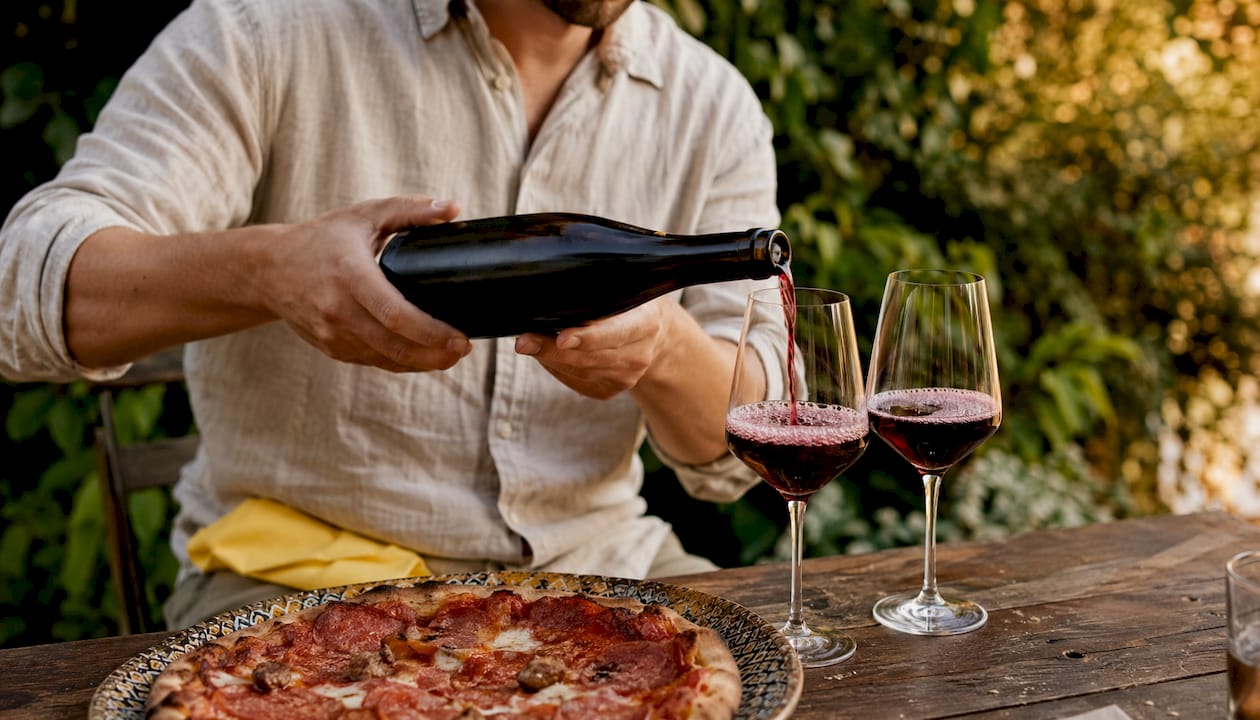
Dry Lambrusco is the sommelier-recommended pick — its acidity, light tannin, and bubbles stand up to greasy, spiced toppings without fighting them. Barbera d’Asti is the still-red alternative: high acid, low tannin, and a natural affinity for cured pork.
Four-cheese and extra-cheese
Franciacorta, Italy’s Champagne-method sparkler, brings richness and fresh acidity together in a way that cuts through heavy dairy without stripping the palate. A dry rosé Prosecco works beautifully too, its red-fruit notes complementing the savory depth of multiple cheeses.
Meat-lovers
Reach for a Sangiovese-based wine with a bit more structure — a Rosso di Montepulciano or a Morellino di Scansano. The wine needs enough body to stand up to multiple proteins without going so tannic that it clashes with the tomato base.
BBQ chicken
BBQ sauce is sweet, smoky, and acidic all at once. A fruit-forward, slightly off-dry style works well here. Look for a Primitivo from Puglia or a lightly oaked Zinfandel if you prefer a California bottle — both carry enough ripe fruit to echo the sauce’s sweetness.
Hawaiian (ham and pineapple)
This is where an off-dry Riesling earns its place. A touch of residual sugar tames the pineapple’s acidity and complements the sweet-savory contrast. A New World Sauvignon Blanc with tropical notes is a solid alternative.
White pizza (bianca)
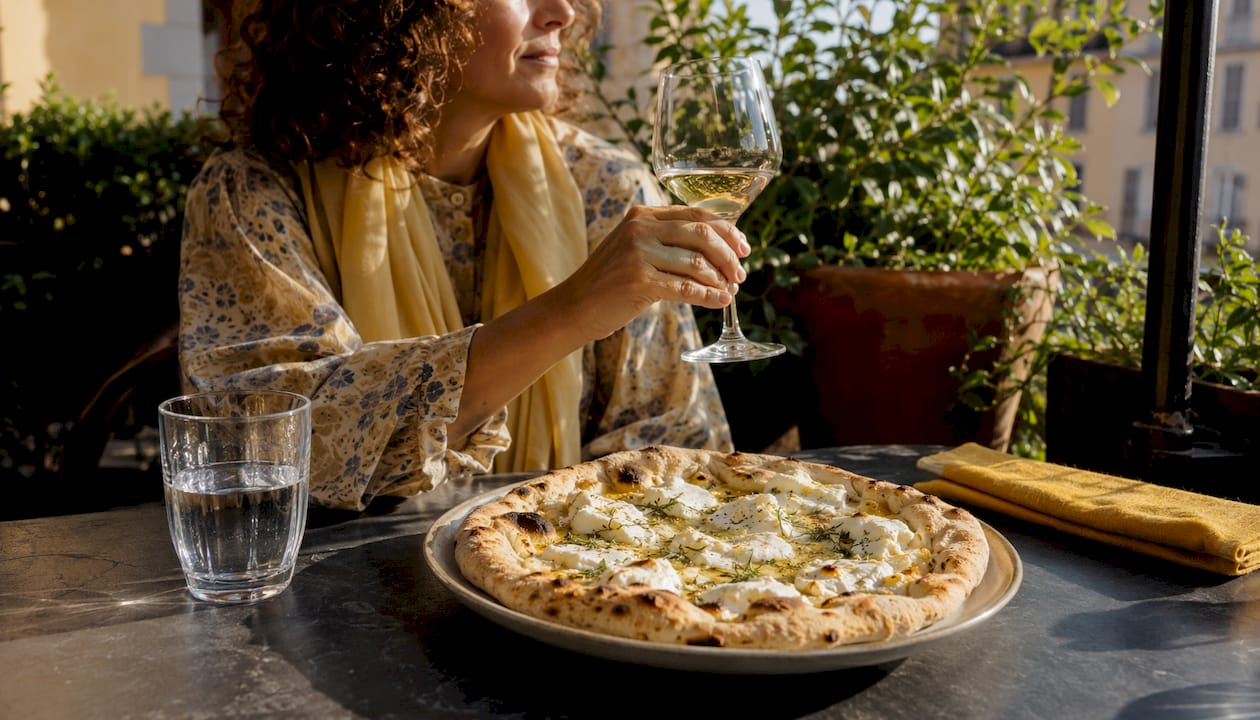
No tomato means no acidity anchor from the sauce, so the wine must supply it. Crisp, high-acid whites — Vermentino, Soave, or Gavi di Gavi — cut through ricotta and cream with a saline freshness that feels made for the job. Sparkling wine works equally well here.
Mushroom and truffle
Aged Pinot Noir with at least a few years of bottle time develops an earthy, forest-floor quality that mirrors mushroom’s umami. For truffle specifically, a white Burgundy or an unoaked Chardonnay echoes the richness without competing.
Vegetable and pizza primavera
A fuller-bodied white like Chenin Blanc handles an abundance of roasted vegetables without getting lost. Its ripe stone-fruit notes and natural acidity keep the pairing lively across a wide range of veggie toppings.
Sicilian style
Sicily’s thick, focaccia-based pie goes heavy on sauce and cheese — it needs a wine with real presence. Nerello Mascalese or an Etna Rosso blend brings volcanic minerality, bright acidity, and enough structure to match the pie’s intensity.
Detroit and Chicago deep-dish
The extra fat and dough mass in thick-crust styles call for wines with more acidity and a bit more body. Barbera handles Detroit-style well. For Chicago deep-dish, a Sangiovese with slightly more concentration — a Brunello di Montalcino if you’re celebrating, a basic Rosso di Montalcino for a weeknight — is a natural fit.
Sparkling and rosé are the most versatile choices for pizza night
Sparkling wine is the single most versatile pizza pairing, according to multiple sommeliers. Effervescence actively cleanses the palate between bites, acidity mirrors tomato sauce, and the fruitiness of most Italian sparklers harmonizes with a wide range of toppings. As Tim Bodell, executive chef at Rustic at Francis Ford Coppola Winery, put it: “There’s no other type of wine that pairs so well with such a vast array of pizza styles and toppings.”
Three go-to sparkling and rosé styles:
- Prosecco Brut: Light, lively, and delicate enough not to overwhelm a classic Margherita. Rosé Prosecco adds red-fruit character that works beautifully with tomato sauce and white pizzas alike.
- Dry Lambrusco: A red sparkler from Emilia-Romagna with the acidity and structure to handle pepperoni, sausage, and mushroom-truffle combinations. Fun, unexpected, and genuinely food-friendly.
- Franciacorta: Italy’s Champagne-method wine, richer and more complex, ideal for cheese-heavy or Margherita pizzas where you want both freshness and depth.
Rosé Prosecco and dry Provence-style rosé also shine with briny or meaty toppings — arugula and prosciutto, sausage and peppers, or anchovy and olive pies. The fruit in a good rosé contends with tomato sauce while balancing bitterness from bold toppings.
Pro Tip: Serve sparkling wines and rosés between 45°F and 50°F. Pull them from the fridge about 20 minutes before opening — not straight from the ice bucket, which can mute the aromatics. Standard white-wine glasses work fine; you don’t need flutes for pizza night.
Budget-friendly picks and a quick shopping checklist
Barbera, Prosecco Brut, and basic Chianti (Sangiovese-based) consistently deliver excellent pizza pairings at accessible price points. These three varietal categories cover most pizza styles and are widely available at supermarkets and wine shops across the US.
Affordable style cues to look for on the label:
- Chianti DOC or Chianti Classico DOCG (basic tier, not Riserva): bright, food-friendly, and usually under $20
- Barbera d’Asti DOC: high acid, low tannin, often the best value red for tomato-based pies
- Prosecco Brut DOC: dry, lively, and widely stocked at every price tier
- Lambrusco secco (dry): avoid the sweet versions; look for “secco” on the label
- Vermentino di Sardegna DOC: crisp and saline, ideal for white pizzas and lighter toppings
- Unoaked Pinot Grigio (Alto Adige or Friuli): clean, fresh, and versatile for cheese and veggie pies
Quick shopping checklist:
- Look for “dry” or “secco” — avoid off-dry unless pairing with sweet toppings
- Check for moderate alcohol (12%–13.5% is the sweet spot for food-friendliness)
- Prefer DOC/DOCG designations for Italian bottles — they signal quality standards
- Choose light-to-medium body over full-bodied for most tomato-based pizzas
- When in doubt between a cheap heavy red and a cheap sparkling, choose the sparkling
How to choose the right wine for any pizza
The decision rule is simple: identify the sauce first, judge the toppings second, and let the crust inform texture last.
Decision checklist:
- What’s the sauce? Tomato base calls for high-acid reds or sparklers. Cream or white sauce calls for crisp whites or sparkling. No sauce means match the dominant topping.
- How fatty and salty are the toppings? More fat and salt = more room for tannin and body. Lighter toppings = stay lighter in the wine.
- Choose acidity, tannin, and body accordingly. High acid always. Tannin only when fat is present. Body should match the overall weight of the pie.
| Sauce type | Wine family |
|---|---|
| Tomato (red sauce) | High-acid reds: Sangiovese, Barbera, Nerello Mascalese |
| White or cream | Crisp whites: Vermentino, Soave, Gavi di Gavi |
| BBQ or sweet | Off-dry or fruit-forward: Primitivo, off-dry Riesling |
| No sauce (bianca) | Match the topping: sparkling or crisp white |
Two quick walk-throughs:
Pepperoni pizza: Tomato sauce (high acid needed) + spiced, fatty meat (some tannin tolerance) = dry Lambrusco or Barbera d’Asti. Both check every box.
White mushroom pizza: No tomato, cream base, earthy topping = aged Pinot Noir for depth, or a crisp Vermentino if you prefer white. The earthiness in both mirrors the mushroom.
Serving temperature, glassware, and pizza night tips
The single most important serving tip: chill your whites and sparklers, and lightly chill your light reds. A Barbera or Chianti served at 58°F is noticeably more refreshing alongside a hot slice than the same wine at 68°F.
Temperature and glassware at a glance:
- Sparkling wines: 45°F–50°F; standard white-wine glass or tulip shape
- Crisp whites (Vermentino, Soave): 48°F–52°F; standard white-wine glass
- Light-to-medium reds (Barbera, Sangiovese, Lambrusco): 55°F–60°F; a universal or Burgundy-style glass works well
- Decanting: not necessary for pizza wines — these are meant to be fresh and immediate
Hosting multiple pizza styles? Open sparklers last-minute to preserve the bubbles. Start guests with the white or sparkling, move to the red as heartier pizzas arrive. If you’re serving both a white and a red-sauce pizza, pour the white first — it won’t compete with the red wine’s tannins.
A simple rule for pairing by slice: when guests are mixing styles on their plates, a dry Lambrusco or Prosecco Brut handles almost every combination on the table. Sourdough-based crusts with strong fermentation character pair especially well with yeast-driven sparklers like Franciacorta, whose autolytic notes echo the dough’s flavor.
Vinumitalia curated picks for pizza night
Vinumitalia sources its bottles directly from small, family-run Italian producers, many of whom farm organically or biodynamically. That approach produces wines with natural acidity, lower intervention, and genuine food-friendliness — exactly the qualities that make a bottle shine alongside a hot pizza.
A short editorial selection by category:
- Sparkler: Look to Vinumitalia’s Agricola Carmina collection for lively, terroir-driven bottles that bring the effervescence and acidity pizza needs.
- High-acid red: The Bosco Agostino collection features Sangiovese-based and Barbera-style reds sourced from small growers — bright, food-friendly, and built for the table.
- Crisp white: Vinumitalia’s biodynamic collection includes low-intervention whites with the saline freshness that works beautifully on white pizzas and lighter pies.
- Versatile rosé: The Vigne e Vini collection carries Italian rosé styles with the fruit and acidity to handle everything from Margherita to prosciutto and arugula.
Editorial note: these picks reflect Vinumitalia’s curated sourcing criteria — organic farming, low-intervention winemaking, and small-producer provenance. They are not paid placements.
Key Takeaways
Match the sauce first, choose high-acid Italian wines over tannic reds, and keep a bottle of dry Lambrusco or Prosecco Brut on hand for any pizza style.
| Point | Details |
|---|---|
| Match the sauce first | Acidity alignment between tomato sauce and wine prevents flat, muddy pairings. |
| Sparkling is most versatile | Prosecco Brut or dry Lambrusco works across nearly every pizza style. |
| Avoid heavy tannic reds | Oak-forward, high-tannin reds clash with tomato acidity and produce a bitter finish. |
| Crisp whites for white pizza | Vermentino, Soave, or Gavi di Gavi cut through cream and ricotta with saline freshness. |
| Vinumitalia for curated picks | Vinumitalia’s small-producer Italian collections offer food-friendly, low-intervention bottles for pizza night. |
The case for keeping it Italian
There’s a tendency in wine circles to treat pizza as a casual, low-stakes occasion — the kind of meal where any bottle will do. We’d push back on that. Pizza is one of the most flavor-complex meals you can eat: fermented dough, caramelized cheese, acidic tomato, cured meat, fresh herbs. That complexity deserves a thoughtful pour.
What we’ve found, working directly with small Italian producers, is that the wines grown closest to where pizza was born tend to be the most naturally food-friendly. Not because of romance or marketing, but because generations of winemakers in Campania, Emilia-Romagna, Tuscany, and Sicily were literally making wine to drink with food. The acidity is built in. The tannins are measured. The alcohol is moderate. These aren’t wines engineered for a tasting room — they’re made for the table.
The other thing worth saying: low-intervention winemaking, which is central to how we source at Vinumitalia, tends to produce wines with more natural brightness and less oak weight. That’s not a philosophical preference — it’s a practical one. Those bottles simply pair better with pizza.
Vinumitalia’s pizza-night wine collections
Pizza night deserves more than a random bottle grabbed on the way home. Vinumitalia brings you hand-selected Italian wines sourced directly from family-run producers — the kind of bottles that are built for the table, not the trophy shelf.
A pizza-night selection from Vinumitalia typically includes a dry sparkler for versatility, a high-acid red for tomato-based pies, and a crisp white for cheese or bianca styles. Every bottle comes from a small Italian producer farming with organic or biodynamic practices, and ships directly to your door across the US.
Browse the full range at Vinumitalia, or explore the organic collection for low-intervention bottles that are as food-friendly as they are expressive. If you’d like to try a curated mix, the full shop lets you filter by producer, region, and style.
Disclosure: Vinumitalia curates and sells the bottles featured in this section. Recommendations throughout the article are editorially independent.
Further reading and sources
- I Asked 5 Sommeliers the Best Wine to Pair With Pizza — Real Simple — Sommelier interviews on why sparkling wine dominates pizza pairings and which Italian styles they prefer.
- Best Wine with Pizza: Pairings That Work — Pairing with Wine — Detailed topping-by-topping breakdown of acidity, tannin, and varietal guidance; primary source for the “match the sauce” rule.
- The Ultimate Guide to Pairing Wine with Every Kind of Pizza — Wine Enthusiast — Comprehensive style-by-style pairings from Margherita to Sicilian, with varietal specifics.
- How to Choose the Perfect Wine for Your Pizza — Travel + Leisure — Sommelier recommendations for Vermentino, Chianti, and Franciacorta across pizza styles.
- Best Wine with Pizza — VinePair — Covers crust-and-wine texture interactions, including sourdough and yeast-driven sparklers.
- Best Wine with Pizza — What Actually Works by Topping — Pairing with Wine — Focused guide on off-dry whites for sweet-savory pizzas like Hawaiian.
- Best Wine with Pizza — Sommy — Concise sommelier rule-of-thumb: high-acid, medium-bodied, low-to-moderate-tannin wines for most pizzas.